
Author: Joseph Ramirez

  • How to get out of your meetings

    How to get out of your meetings

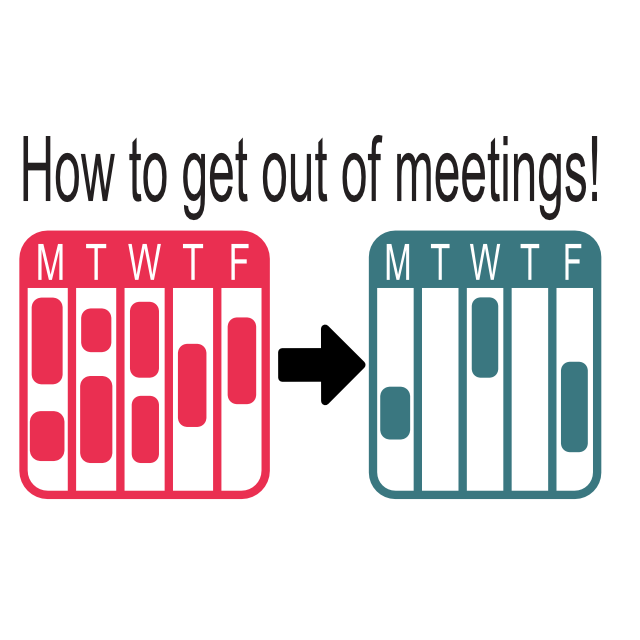
    Interrupting your flow to attend a meeting is frustrating and an all too common occurrence. Because while meetings can be a powerful team building and decision making tool, they can also be a huge productivity killer.

    First, You should always keep and prioritize your one-on-ones. Those are the most important meetings you have and you should always prepare for them .

    For your other meetings, here is a list of ways to help you review and vet your meetings for value.

    Choose to attend only key presentations

    Presentations normally have a recording and slides that go along with them. Which means you can take in the information at a better time for you. Just make sure you do! You might be held responsible for knowing the information. Don’t wait to long to watch them as you might miss your opportunity for to give feedback.

    When in doubt talk to your manager and explain that your time would be better spent doing your other work.

    • See if you can watch the video and read the slides later

    Battle your F.O.M.O.

    Your fear of missing out (FOMO) could be the reason you are attending a lot of your many meetings. However the truth is if you don’t contribute to the discussion with questions and/or answers, there’s no reason to be there. You can get the updates or watch the recording later.  If you are marked optional, decline the meeting. 

    I think it is also worth mentioning, being a spectator in lots of meetings will not get your promotion.  As a manager, I considered people’s contribution in meetings as part of the promotion and review discussions. If you are leading and driving decisions, that will help, not watching others. 

    If you are unsure about contributing, ask the scheduler  what their expectations are of you. Once you are marked “optional” or agreed with the scheduler that you are, decline the meeting. 

    • Decline meetings if you don’t see value and can’t contribute. Especially if you are optional.
    • Being a spectator won’t get you promoted

    Require an agenda and goal for the meeting

    Don’t accept any meeting with no description and an ambiguous title. There is no way to judge if you are even the correct person for the meeting! Take this as your opportunity to turn the meeting into an email. 

    Reach out to the scheduler and ask for an agenda and the goal of the meeting. If you don’t get them with enough time to prepare, decline the meeting or ask for it to be rescheduled until you can review an agenda. 

    With the agenda and goal in hand, see if you can answer everything in an email. Yes, try to turn the meeting into an email! I have easily gotten out of 20% of my meetings by asking for the agenda and then sending documentation or answering their questions. Even if I couldn’t get out of it, the meeting went much better with the agenda and goal. 

    • Ask for an agenda and goal before the meeting
    • Try to answer everything via email

    Get another representative

    At this point you are no longer optional and feel like you can contribute based on the agenda. However there might be another out, ask yourself “Can another person take your place?”.

    Look at the invite list and see if there is another that can be the representative for the team. Maybe this would be a good growth opportunity for someone else to lead. If you can identify someone else, sync with them and make sure you both share the same ideas.

    • Review the invites and see if another representative attend.
    • See if this meeting is a growth opportunity for someone else.

    Ask if the meeting was valuable

    As I cleared off my one-time meetings, I realized how many  recurring meetings I was participating in. At first all I was reluctant to do anything to them as they were all valuable.. at least at one point. Were they still valuable? 

    I evaluated the last two meetings in each recurring meeting.  I gave the meeting a mental “check” if I contributed, I found value and we filled the time with meaningful content.  Any series with two checks was kept. 

    Those meetings without two checks were on the chopping block. The next occurrence of the meeting I asked everyone If they found it valuable. If they did, then could we increase the time between meetings to have more to talk about. Going from every two weeks to once a month or quarterly.

    With these methods, I was able to cancel a bunch of those never-ending recurring meetings. Other meetings were bumped up to quarterly meetups. A surprising side effect was better attendance due to the infrequency of the meeting.

    • Continuously audit recurring meetings for value
    • Try increasing the time between occurrences

    Let me know how these work for you

    You hopefully have some ways to get out of some of your meetings! This by no means you won’t have any meetings, but hopefully the meetings you do have will be better and you will find them valuable.

    Give these a try and let me know how they work for you! Are their other techniques you use to cut the number of meetings you are in?

  • Preparing for your one-on-one

    Preparing for your one-on-one

    It wasn’t until I became a manager that I realized how poorly I handled one-on-ones as an individual contributor. I rarely understood their purpose and came unprepared. When I began management training, I recognized how effective some of my managers had been—how they drew me out and asked questions that helped me organize and articulate my thoughts. Now, I understand just how crucial these conversations are.

    One-on-ones are a fantastic opportunity to chat about your goals, team opportunities, challenges, and career aspirations. They can be a great way to assess whether you’re on the right track in your current job and a chance to receive coaching and mentorship. As a manager, you get a fresh take on how your team is performing, how everyone sees themselves, and how you’re doing too! 

    My goal is to help people prepare for one-on-ones—IC and manager alike. Like any meeting, you should come prepared. Don’t cram this into the 10–15 minutes before it starts. To get the most value from your one-on-one you might need to prepare for 1-2 hours, it’s ok! You are worth it! 

    In between one-on-ones

    I suggest scheduling a recurring meeting midway between your one-ones—like a check-in with yourself. You will be working on a list of talking points by reviewing your notes from the previous two one-on-ones. (If you don’t have notes, start taking them now.), your previous lists of talking points and adding new talking points.

    Aim to fill 30 minutes of the next one-on-one with your own topics and feedback. This will likely be too much, but that’s okay! The backlog will help you in future one-on-ones, and you can always send an email to discuss topics outside the meeting. Focus on topics that have value being discussed in person. Other topics can be handled through different forms of communication.

    Individual Contributor

    During this time, start looking for wins and thinking about feedback. I recommend using the feedback equation for topics like the team processes, team members, your work, the manager, and other areas.

    • List accomplishments and wins, especially those related to your goals
      • You fixed a tough bug
      • You completed more points, stories, or tickets than ever before
      • You unblocked yourself on something difficult
    • List 2 pieces of feedback you want to discuss
      • Team members
      • Processes
      • Blockers
      • Your current projects
      • pain points
    • One discussion points related to broader topics
      • Your career
      • Coaching and mentoring
      • Work you would like

    Manager

    Prepare 10 minutes of topics and feedback. Focus on items best discussed in person.

    • Recognize your report’s wins and accomplishments—don’t wait for the one-on-one to share this.
    • List two areas where you want feedback
      • Team processes
      • Yourself
      • The project
      • Other areas
    • List possible feedback for your them

    The day before

    This is the time to prioritize what you want to discuss and prepare your talking points. Make sure you can easily access your notes during the meeting—whether that’s handwritten on paper, on Post-its around your monitor, or in a notes app. Make sure your ideas are fully developed and you know how to articulate them clearly.

    Individual Contributor

    Prepare to drive the conversation. You should be doing 80% of the talking.

    • Prepare to talk about your wins, especially related to any action items from your last 1:1 , goals, or personal achievements. Aim to mention:
      • What actions you took
      • How the achievement imacts your goals and/or the team
      • What you learned from the achievement
    • Prepare two pieces of feedback about new process, improvements you think can be made, pain points..etc.

    Manager

    You should be doing more listening than talking, this is your chance to get their view of how things are going and how they see the team.

    • Prepare two discussion questions.
    • Prepare to mention any wins you have noticed and to ask them about their wins.
    • Prepare at most one piece of feedback to discuss.

    15 – 10 – 5 minutes before

    All of your preparation will be for naught if you aren’t mentally ready. When I had an upcoming one-on-one with my manager, this is what I would do to prepare. My goal was to go in clear headed and calm so I was ready to both give and receive feedback.

    When I had a one-on-one with someone reporting to me, the steps were the same. It’s still important to go in with a clear mind ready to give your full attention to the person you’re talking with. 

    Fifteen minutes before
    Stop other work, nothing is more distracting than trying to solve finish whatever you were working on in your head while trying to have your one-one. Make sure you have ready whatever you need for the meeting — your talking points, a drink, headphones etc. Take a little walk or just stand up and stretch.

    Ten minutes before
    Time to review your talking points and last chance to reprioritize anything. Now isn’t the time to make big changes! If you don’t feel confident about a talking point then drop it for now.

    5 minutes before
    Now is just some time to relax and have a breather. Maybe do a little meditation, enjoy a view out of the window or something relaxing.

    Try it out and let me know!

    Preparing for your one-on-one meeting is super important! You only have a short amount of time with your manager or individual contributor , so making the most of it is key.  You need to go in prepared and in the right state of mind.

    Give this a try and let me know how it goes! Feel free to change it to fit your needs. I went through a lot of different versions and would love to hear how you modify it. What are you already doing that you think others should know about?